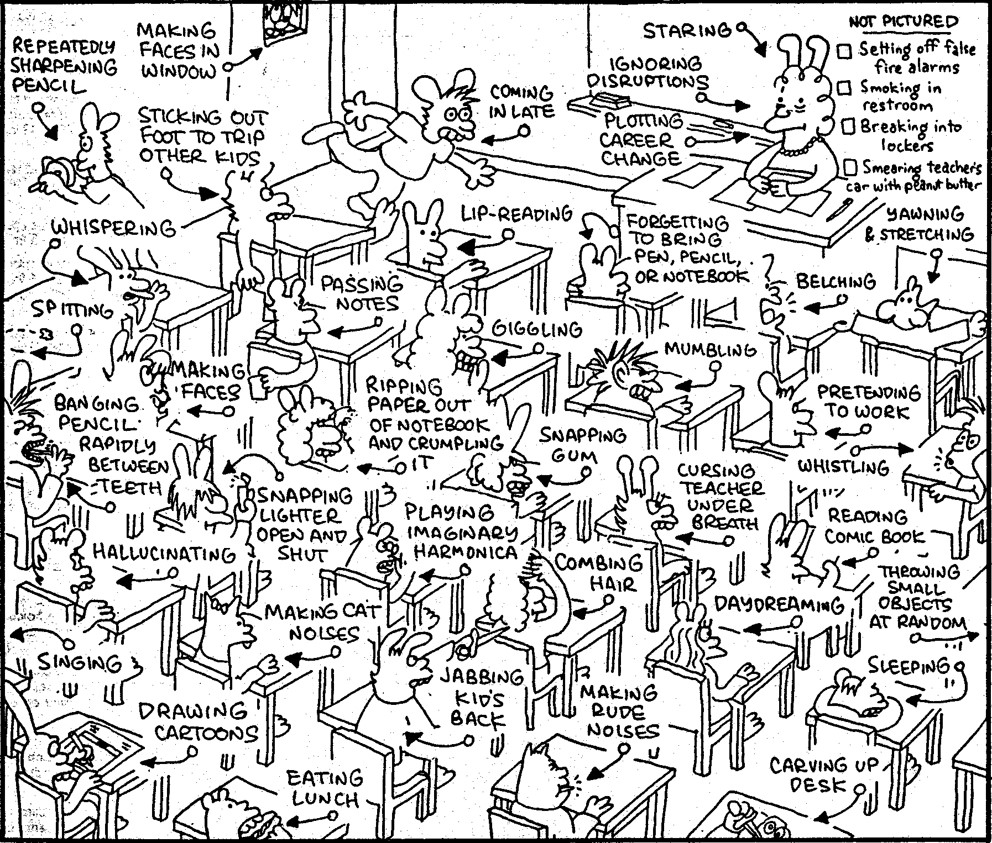
This is one of my favourite cartoons, illustrating how teachers can easily make up to 800 micro-decisions a day relating to the teaching and learning of their students. And this image doesn’t even include the different levels of understanding of each student, nor their different interests, nor the different associations that students will make in their brains as the teacher triggers different experiences, feelings, memories – gestalts, in the minds of each student.
One could argue that on the 734th decision about whether to acknowledge Sara’s elevated hand to ask a question, or continue with getting through the curriculum, or somehow awaken the boys at the back, and also stop Jose from annoying Mei, that the academic research alone around what works best is not going to be either at the forefront of the teacher’s mind nor necessarily helpful to what is happening in front of them. Indeed Dylan Wiliam argued recently that we need to recognise that there are many instances in teaching where teachers need to make decisions where there is no research evidence, and also realising that sometimes the research that is available may not be applicable in a particular context (Wiliam, 2019).
Instead, the decision by an expert teacher is more likely to be an amalgam of what they know about their students, what they’ve learned from their colleagues, what they know from the research literature and a reflective self-knowledge of their personal experiences and personality traits which gear them towards acting in a particular way (Brookfield, 1994).
In this way, instead of looking only at the scientism on THE evidence of what works in teaching, we are probably better off placing our emphasis on supporting teacher skills, knowledge and awareness for decision-making in the moment. That is, in the moment, to be able to step outside of our own automatic patterns, to be become aware and conscious our own internal biases and experiences, to reflect on our knowledge of the conceptual terrain that students will most likely follow, and choose from the repertoire of pedagogical strategies that will most likely work with these students for this content in this particular context.
It is this ‘teacher evidence’ that expert teachers possess, and it is the type of evidence that school leaders and education policy makers should invest in if we are serious about entering a new era in education.
Reference
Wiliam, D. (2019) Teaching not a research-based profession. https://www.tes.com/news/dylan-wiliam-teaching-not-research-based-profession
 Teaching Wisdom